
DIR/Floortime: What It Is, What It Isn't, and Why It Matters
- Jun 24
- 4 min read
If you've recently heard about DIR/Floortime and are wondering what it actually is, you're not alone.
Many parents find themselves searching for alternatives to traditional therapy approaches that focus primarily on compliance, behavior management, or isolated skill-building. They want to understand their child more deeply—not just change their behavior.
DIR/Floortime offers a different perspective.
At Child & Family Development, we often hear parents say:
"I've heard of Floortime, but I'm not really sure what it is."
"Isn't it just playing?"
"My child doesn't want to play with me. How could this help?"
"Will my child actually learn skills?"
The short answer is yes—but probably not in the way you think.
What Does DIR Stand For?
DIR stands for:
Developmental – Understanding where a child is in their emotional, social, communication, and cognitive development.
Individual Differences – Recognizing that every child's nervous system, sensory processing, motor abilities, medical history, and learning style are unique.
Relationship-Based – Understanding that growth happens through meaningful relationships and interactions with caregivers, therapists, teachers, and peers.
Rather than asking: "How do we stop this behavior?"
DIR encourages us to ask: "What is this behavior communicating, and what developmental skills does this child need to be successful?"
This shift changes everything.
What Is Floortime?
Floortime is the practical application of the DIR model.
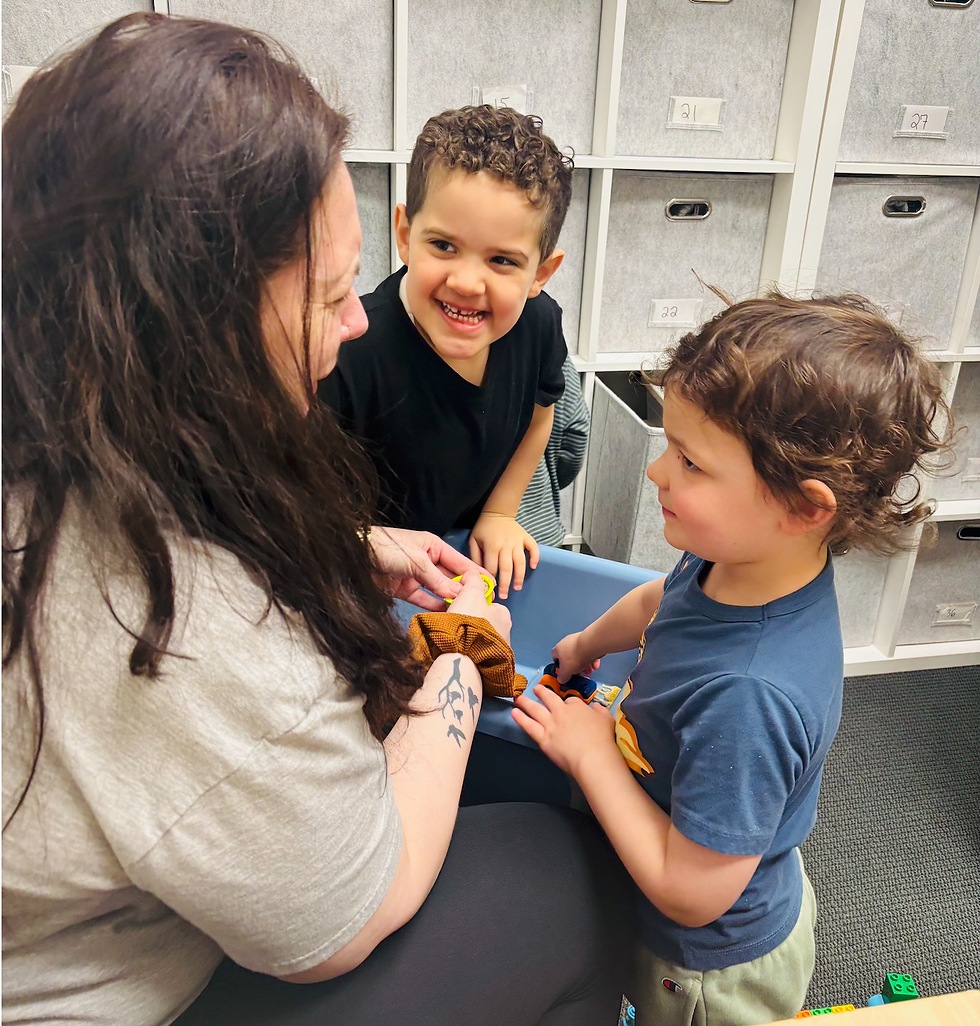
Despite the name, Floortime doesn't actually require sitting on the floor. Floortime is a therapeutic approach where adults enter the child's world, follow their interests, and create opportunities for meaningful interaction, communication, problem-solving, and emotional growth.
The goal isn't simply to entertain a child.
The goal is to use shared engagement and relationships to help a child develop:
Attention and regulation
Communication skills
Emotional regulation
Social interaction
Problem-solving abilities
Flexible thinking
Self-confidence
Sense of self
Creativity and imagination
The Real Goal Is Development
One of the biggest misconceptions about therapy is that skills develop best through direct teaching.
While direct instruction has its place, developmental science tells us that higher-level thinking, communication, emotional regulation, and social understanding emerge from foundational developmental capacities.
For example: A child may be taught to say "I'm frustrated."
But if they cannot recognize frustration in their body, regulate themselves, and trust another person enough to seek support, the phrase may have little meaning in real-life situations.
DIR/Floortime helps build the foundation beneath the skill.
Commonly Misunderstood Components of DIR/Floortime
Misconception #1: "It's Just Play."
This is probably the most common misunderstanding. DIR/Floortime uses play because play is the natural language of childhood.
However, therapeutic Floortime is highly intentional.
A skilled DIR practitioner is continuously observing:
Regulation
Sensory processing
Motor planning
Attention
Communication
Emotional signaling
Problem-solving
Social reciprocity
Developmental capacities
What looks like simple play often involves sophisticated therapeutic intervention designed to support development.
Play is the vehicle. Development is the destination.
Misconception #2: "There Are No Goals."
DIR/Floortime is often incorrectly described as "unstructured." In reality, therapy goals are carefully individualized.
A session may target:
Expanding engagement
Increasing back-and-forth communication
Improving frustration tolerance
Supporting symbolic play
Developing peer interactions
Strengthening emotional regulation
Building executive functioning skills
The difference is that goals are often embedded naturally within meaningful interactions rather than practiced through repetitive drills.
Misconception #3: "Following the Child Means Letting Them Do Whatever They Want."
Following a child's lead does not mean giving up boundaries. It means starting with the child's interests and motivations.
A therapist may join a child's interest in dinosaurs, trains, art, water play, or movement because motivation creates the best opportunity for learning.
Within those interests, therapists challenge children to:
Problem solve
Communicate
Negotiate
Think flexibly
Regulate emotions
Connect with others
The child is leading the theme. The therapist is supporting development.
Misconception #4: "DIR/Floortime Doesn't Address Behavior."
DIR/Floortime absolutely addresses behavior. It simply views behavior differently.
Instead of asking: "How do we stop this behavior?"
We ask: "Why is this behavior happening?"
Behavior is often influenced by:
Sensory processing differences
Anxiety
Communication challenges
Motor planning difficulties
Emotional overwhelm
Developmental skill gaps
Environmental demands
When we understand the underlying cause, we can support lasting change rather than simply suppressing symptoms.
Misconception #5: "Children Need to Learn Compliance."
Many families come to us because they have been told their child simply needs to be more compliant. DIR/Floortime focuses on connection before compliance.
Research consistently demonstrates that learning occurs most effectively when children feel safe, connected, and regulated.
Rather than teaching blind obedience, DIR/Floortime supports:
Self-regulation
Flexible thinking
Emotional awareness
Problem-solving
Social understanding
Internal motivation
These skills create lifelong resilience.
Misconception #6: "DIR/Floortime Is Only for Autism."
While DIR/Floortime is widely recognized for supporting autistic children, it is not limited to autism.
The model can benefit children experiencing:
ADHD
Sensory processing differences
Anxiety
Developmental delays
Social-emotional challenges
Feeding difficulties
Communication differences
Executive functioning challenges
Genetic and neurological conditions
Because DIR focuses on development rather than diagnosis, it can be adapted to many different needs.
Why Relationships Matter
Modern neuroscience continues to show that development occurs within relationships.
Children learn to regulate emotions through co-regulation.
They learn communication through interaction.
They develop confidence through feeling understood.
They build resilience through safe, supportive relationships.
DIR/Floortime recognizes that relationships are not separate from development.
Relationships are the foundation of development.
What Does Progress Look Like?
Progress in DIR/Floortime may look different than families initially expect.
Instead of focusing solely on isolated skills, families often notice:
More eye contact
Increased engagement
Better emotional regulation
More spontaneous communication
Greater flexibility
Improved confidence
Richer play skills
Stronger relationships
More curiosity and creativity
These changes create a foundation that supports learning across all areas of life.
The Bottom Line
DIR/Floortime is far more than a play-based therapy. It is a comprehensive developmental framework that recognizes that every child develops through a unique combination of relationships, experiences, sensory processing, and emotional growth.
Rather than asking children to fit into a predetermined mold, DIR/Floortime seeks to understand who they are, how they experience the world, and what supports they need to thrive.
When children feel safe, understood, and connected, remarkable growth becomes possible.
Because meaningful development doesn't happen through compliance.
It happens through connection.

Comments