
🌱 Why Imitation Matters for Development
- Jan 2
- 2 min read
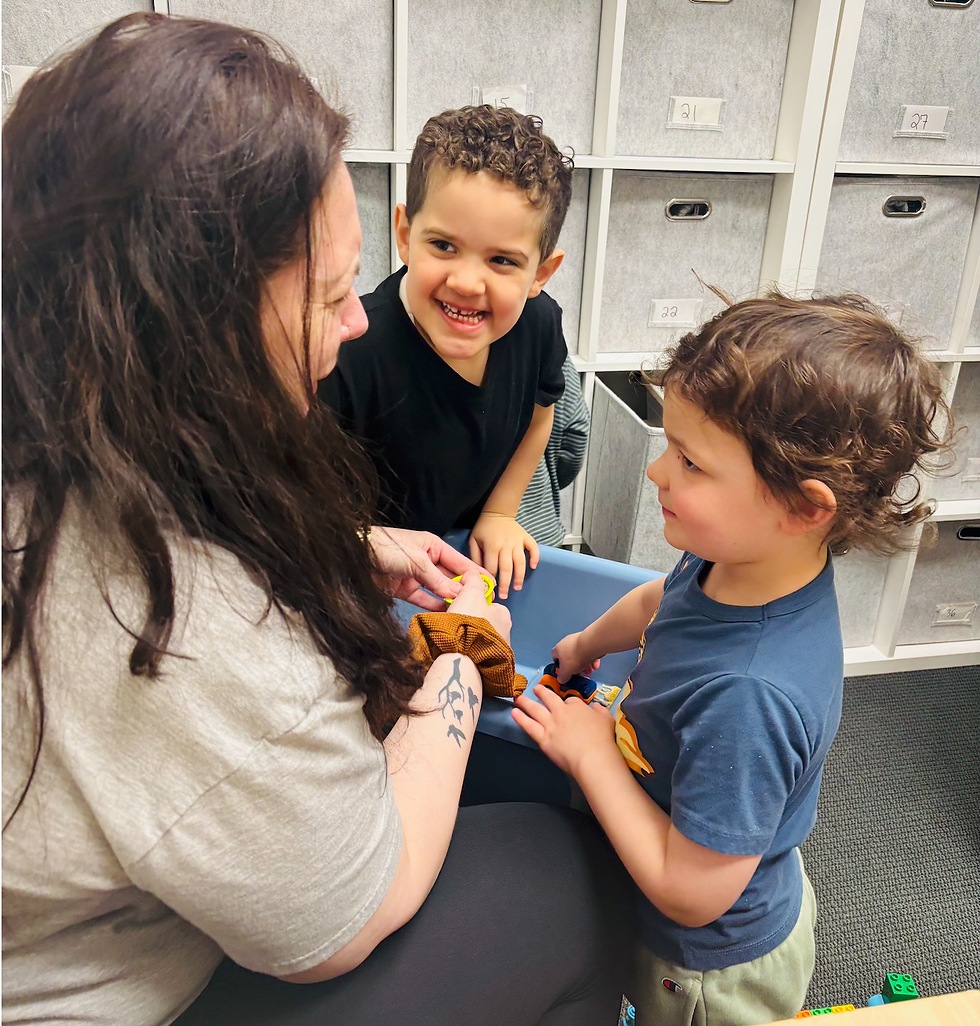
Imitation is one of the earliest ways children learn. From copying a smile to repeating words or actions, imitation is how children begin to understand others, practice new skills, and build social connections. It is both a foundation for learning and a bridge to communication and relationships.
💛 For Parents
Building Connection: When your child imitates you (or you imitate them), it strengthens your bond and shows that you are “in tune” with one another.
Learning Through Play: Copying actions helps children try out new movements, explore cause and effect, and gain confidence.
Language Development: Many children first learn words by repeating (imitating) sounds, gestures, and facial expressions.
Social Skills: Imitation is often the first step in turn-taking, joint attention, and learning how to interact with peers.
🧠 For Professionals
Developmental Milestone: Imitation emerges in infancy and is a predictor of later communication, play, and social-emotional skills (Meltzoff & Moore, 1997).
Intervention Value: Targeting imitation in therapy (e.g., through modeling, reciprocal play, or Floortime) supports not only skill acquisition but also relationship-building (Ingersoll, 2008).
Autism & Developmental Disorders: Difficulties with imitation are common in autism spectrum disorder (ASD), making it a critical focus for early intervention (Rogers & Dawson, 2010).
Neuroscience Basis: Mirror neuron systems play a role in imitation, linking action observation with execution — helping children “learn by watching” (Iacoboni, 2009).
📚 Key References
Meltzoff, A. N., & Moore, M. K. (1997). Explaining facial imitation: A theoretical model. Early Development and Parenting, 6(3–4), 179–192.
Ingersoll, B. (2008). The social role of imitation in autism: Implications for the treatment of imitation deficits. Infant and Young Children, 21(2), 107–119.
Rogers, S. J., & Dawson, G. (2010). Early Start Denver Model for young children with autism: Promoting language, learning, and engagement. Guilford Press.
Iacoboni, M. (2009). Imitation, empathy, and mirror neurons. Annual Review of Psychology, 60, 653–670.
✨ Takeaway: Imitation is much more than “copying.” It’s how children learn to connect, communicate, and grow. Supporting imitation in playful, relationship-based ways lays the foundation for lifelong learning and social success.


Comments